SMS links: what CTIA recommends, link length and a pre-send check
What CTIA's messaging best practices say about links in texts, why a link on your own domain builds trust, how links change SMS length, and a pre-send check.
Key takeaways
- CTIA's Messaging Principles and Best Practices (May 2023) say a sender that uses a URL shortener should use one with a web address dedicated to its exclusive use.
- Carriers control the sender ID: the name or number a message comes from. They do not approve or block the links inside your message, and no carrier rule we could open names a shortener.
- A branded short domain is recognisable, belongs to you alone and keeps the message short: b1.lc/AbC9 is 10 characters, while a tagged landing page URL easily runs to 100.
- One plain-text SMS segment holds 160 GSM-7 characters, or 70 if any character forces Unicode; a long link or one curly quote can double the cost.
- BN Shortener's SMS message check flags public shorteners, http links and Unicode characters, and notes missing opt-out wording (warning on promotional UAE and Saudi routes), before you send.
A text message with a link is one of the most direct ways to reach a customer, and people have learned to be careful with links in texts. This guide separates what is published from what is folklore, explains why a link that names the sender earns more trust, shows how links change the length of a message, and ends with a checklist to run before you send.
Who controls what in an SMS?
Carriers control the sender ID: the name or number a message comes from, and the registration behind it. They do not approve or block the links in your message, and no carrier rule we could open names a shortener. The links, and what they lead to, are your responsibility.
CTIA, the US wireless industry association, says in its Messaging Principles and Best Practices (May 2023) that service providers may filter or block unwanted messages. That document does not say links on your own domain are delivered differently, and we make no such claim.
Why a link that names the sender matters
A public shortener domain is used by everyone: your shipping update, a stranger’s phishing message and a bot’s spam blast may all start with the same hostname. A link that starts with a generic shortener says nothing about who sent it, so people who have been taught to be careful with links will hesitate. A link on your own domain shows recipients who sent it.
What do the CTIA guidelines say about short links?
Section 5.3.2, “Embedded Website Links”, is the part that matters. It says three things:
- Senders “should ensure that links to websites embedded within a message do not conceal or obscure the Message Sender’s identity.”
- “Where a web address (i.e., Uniform Resource Locator (URL)) shortener is used, Message Senders should use a shortener with a web address and IP address(es) dedicated to the exclusive use of the Message Sender.”
- Web addresses in messages, and the sites they redirect to, “should unambiguously identify the website owner” and include contact information such as a postal address.
These are best practices from an industry association, not a law, and the same document says each provider applies its own policies.
What we could and could not verify
| Claim you will hear | Verified on 23 October 2026? | Source |
|---|---|---|
| Industry guidance asks senders to use a shortener dedicated to them | Yes | CTIA, May 2023, section 5.3.2 |
| Service providers may filter or block unwanted messages | Yes | CTIA, May 2023, sections 3 and 7 |
| Opt-out instructions should be in the message, with standard “STOP” wording | Yes | CTIA, May 2023, section 5.1.3 |
| A named carrier blocks specific public shortener domains | Not verified | We could not open a carrier’s own code of conduct; reports come from messaging vendors |
| A branded domain is required by carriers | Not verified | No carrier document we opened says so |
We could not find a newer edition of CTIA’s document than May 2023. If you send in volume in the US, ask your messaging provider for the current rules that apply to your number type.
One detail is worth being straight about. CTIA’s wording mentions a web address and IP addresses dedicated to the sender. A custom domain on BN Shortener is yours alone, but it points at BN’s servers by CNAME, so the servers behind it are shared. If you need dedicated IP addresses as well, that is a conversation for your messaging provider and for sales.
How does a branded domain help?
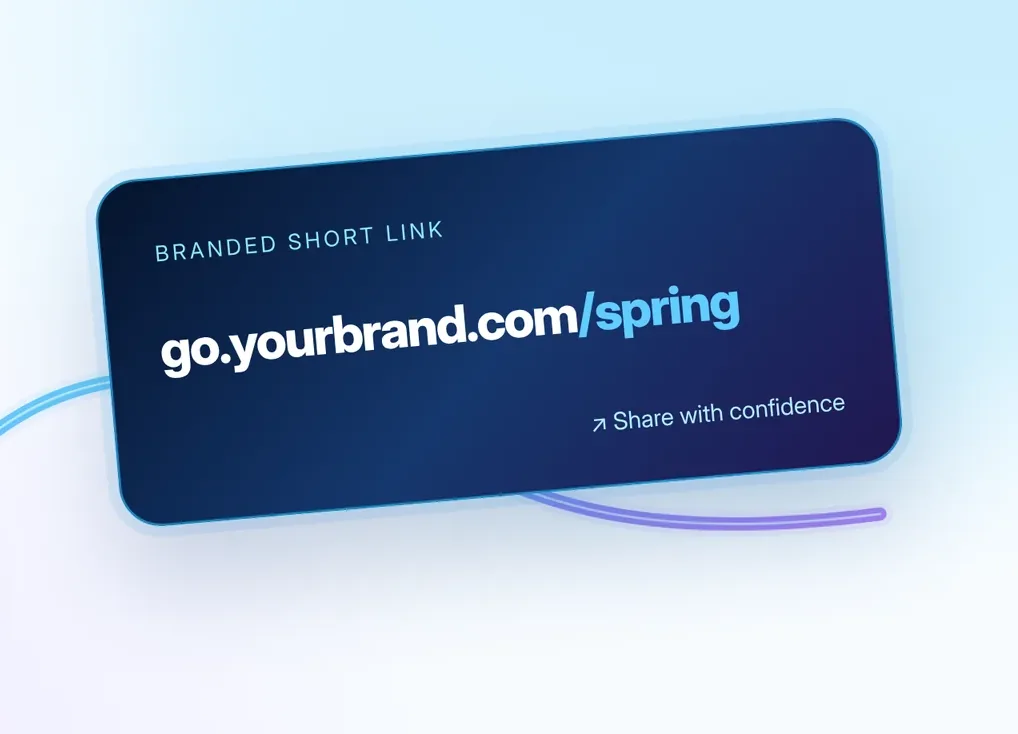
A short link on your own domain, such as go.yourbrand.com/sale, follows CTIA’s recommendation and helps the reader:
- It is dedicated to you. Nobody else’s links share the hostname.
- It names the sender. People can see whose link it is before they tap.
- It stays short. A custom short domain with a short back-half is usually 15 to 25 characters.
- It survives a change of provider. You can repoint the domain without changing a printed or sent link.
See what is a branded link and use your own domain for short links for setup. In BN Shortener, a custom domain can also be attached to an SMS sender ID, so every link that sender sends uses your domain.
How long can an SMS link be?
Every character of the link counts towards the message length, and SMS is billed per segment:
| Encoding | One segment | Each part when split |
|---|---|---|
| GSM-7 (plain Latin text) | 160 characters | 153 characters |
| Unicode (UCS-2) | 70 characters | 67 characters |
Characters from the GSM extension table, such as ^ { } [ ] ~ | \ and the euro sign, count double. One emoji, curly quote or long dash switches the whole message to Unicode.
Here is how the link alone eats into a 160-character message (illustrative examples):
| Link style | Example | Characters |
|---|---|---|
| Full tagged URL | https://www.yourbrand.com/collections/spring-sale?utm_source=sms&utm_medium=sms&utm_campaign=spring | 99 |
| Shared short domain | b1.lc/AbC9 | 10 |
| Branded short domain | go.yourbrand.com/spring | 23 |
| Branded, with https:// | https://go.yourbrand.com/spring | 31 |
Paste your full message into the free SMS character counter to see the encoding, the segment count and the characters that forced Unicode.
Should I send the full URL instead of a short link?
Sometimes, yes. A full URL on your own website domain names the sender as clearly as anything can, and it involves no shortener at all. The cost is length: a tagged landing page address can eat most of a 160-character message on its own, and it is harder to read on a small screen.
BN supports both approaches for BroadNet senders. Each saved sender ID can carry links as a short link on your domain or as a long link, the page itself with a small tracking parameter (?bn_m=...); in long link mode a script on your website reports the visit, so clicks are still counted per message. That lets you choose per sender: long links where the destination address is short and well known, branded short links where space is tight.
What else should you check before sending?
The link is one part of the message. Before a send, check each of these:
- HTTPS, not HTTP. Send people to a secure page; BN’s SMS check warns on any
http://link. - One link per message. Two links make the message longer and look more like spam.
- A working destination. A link that leads to an error or a parked page wastes the message and looks careless. Test it on a phone.
- Opt-out wording. CTIA says messages should state how to opt out and that standardised “STOP” wording should be used.
- A registered sender ID. The sender ID is the part carriers control: register it, and follow each route’s rules. The routes BroadNet has confirmed for promotional messages:
| Route | Promotional sender marker | Promotional quiet hours |
|---|---|---|
| United Arab Emirates | “AD-” before the sender name | 21:00 to 07:00 |
| Saudi Arabia | “-AD” after the sender name | 22:00 to 09:00 (01:00 to 12:00 in Ramadan) |
- Previews and scanners. Phones and security tools may open a link before a person does; don’t mistake them for clicks. See how to track SMS links.
How does BN Shortener check an SMS before you send it?
BN Shortener (the service behind Shortlen, at b1.lc) has an SMS message check on the Launch Check page. Paste the full text, up to 5,000 characters, and it checks it as you type; it never sends a message:
- Encoding and length: GSM-7 or Unicode, number of parts, characters left, and the characters that forced Unicode, with a “Replace all” option for GSM-safe equivalents.
- Links: your own BN links with their Launch Check verdict; it fails on public shorteners (41 known, such as bit.ly, tinyurl.com, t.co, goo.gl, ow.ly, rebrand.ly, cutt.ly, short.io, linktr.ee and dub.sh), on unknown, disabled or “Not ready” links, and warns on
http://links and more than one link. - Opt-out wording in English and Arabic: it notes missing opt-out wording (and warns on promotional UAE and Saudi routes).
- Route options: for a chosen country, sender and send time it also checks the promotional sender marker and quiet hours for the UAE and Saudi Arabia.
For sending itself, BroadNet is BN’s SMS and OmniChannels provider, and the messaging features are part of the Enterprise plan: one 9-character link per message, delivery receipts, previews counted apart from clicks, and conversions per batch. Messaging links never store phone numbers. See SMS links.
Checklist before you send an SMS with a link
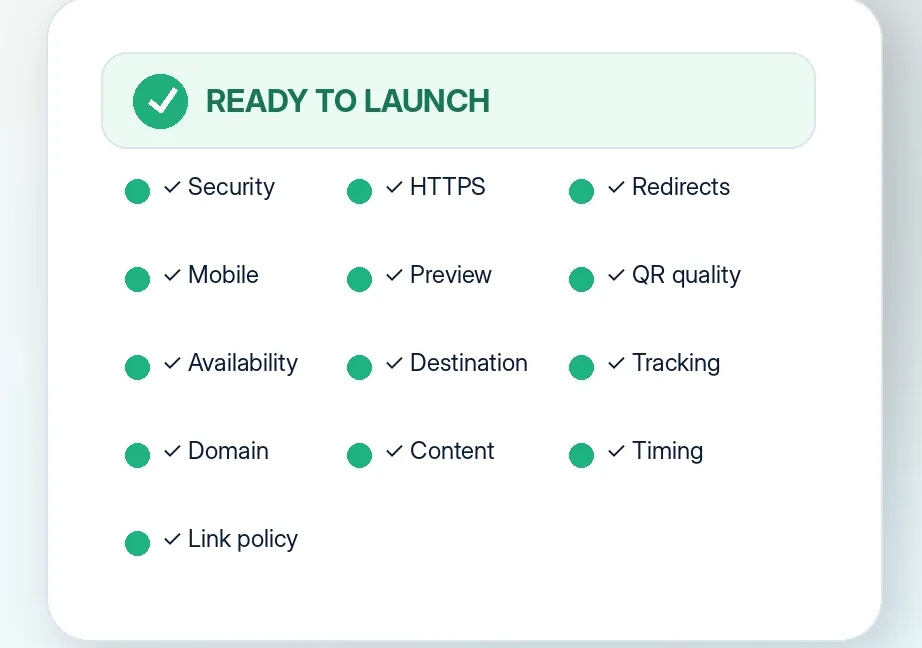
- Links use your own short domain, not a public shortener, so recipients can see who sent them.
- The domain and the landing page clearly identify your business, with contact details on the page.
- Exactly one link, written with HTTPS.
- The destination loads on a phone, is not parked and does not redirect through several hops.
- The message includes “Reply STOP to opt out” or equivalent wording.
- The text stays in GSM-7 and fits the segments you budgeted for.
- Your sender ID is registered, and promotional messages follow the route’s marker and quiet hours.
- You checked the current rules for your number type with your messaging provider.
- Previews and people are reported separately after the send.
Start free or talk to us
You can start free at b1.lc with one custom domain and run the SMS message check before your next send. For BroadNet SMS with one tracked link per message and delivery receipts, talk to sales about Enterprise; the pricing page shows what each plan includes.
Sources
- Messaging Principles and Best Practices (May 2023), CTIA, 2023-05. Checked 2026-10-23.
- GSM 03.38 (GSM 7-bit default alphabet), Wikipedia, undated. Checked 2026-10-23.